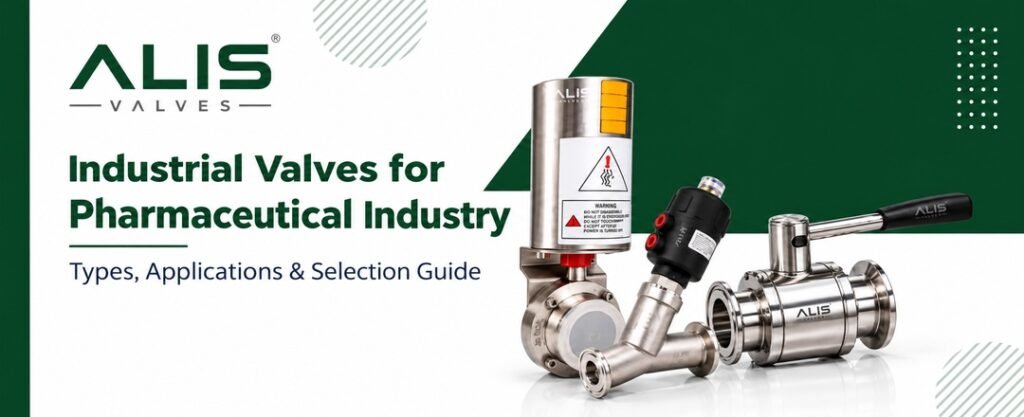
The pharmaceutical industry depends on controlled manufacturing processes, reliable equipment and consistent product quality. From purified water distribution and chemical dosing to utility management and wastewater treatment, every component in a pharmaceutical plant must be suitable for its intended duty.
Valves play an important role in these systems. They help operators isolate equipment, control fluid movement, prevent reverse flow and maintain the required operating conditions. However, selecting a valve for a pharmaceutical facility involves more than choosing the correct size or pressure rating. The process medium, material compatibility, internal design, cleaning requirements and documentation must also be considered.
Industrial valves for pharmaceutical industry applications should be selected according to the specific process, operating conditions and project requirements. A valve suitable for a cooling water line may not be appropriate for a purified water loop or a product-contact application.
For plant engineers, maintenance teams, EPC contractors, project consultants and purchase departments, understanding these differences can help prevent specification errors, reduce unnecessary replacement costs and improve the quality of vendor quotations.
This guide covers the major valve types, pharmaceutical plant applications, material selection, hygienic design considerations, automation requirements and technical information buyers should prepare before requesting a quotation.
1. Where Are Valves Used in Pharmaceutical Plants?
Pharmaceutical facilities contain several interconnected piping and utility systems. Each system has its own operating conditions, fluid characteristics and maintenance requirements. The valve selection process should begin by identifying the function of the piping line and the consequences of a valve failure.
Common applications include the following.
Purified Water Systems
Purified water is used in various pharmaceutical manufacturing and cleaning operations, depending on the process and applicable requirements. Valves in these systems may need to meet specific expectations for material suitability, cleanability, drainability and resistance to the sanitisation methods used.
The valve design should be reviewed as part of the complete water system rather than selected as an isolated component.
Water Treatment and Reverse Osmosis Plants
Pharmaceutical facilities may have raw water treatment, filtration, softening, reverse osmosis and other water preparation stages.
Depending on the system, suitable valves may be required for isolation, backflow prevention, chemical dosing and maintenance. Pressure rating, water chemistry, connection type and compatibility with treatment chemicals should be confirmed before selection.
Chemical Dosing and Transfer Lines
Chemical handling systems require careful consideration of the fluid’s concentration, temperature and corrosive properties. The body material alone is not enough to establish suitability; seats, seals, diaphragms and other wetted components must also be compatible.
Engineers should provide the supplier with the chemical name and concentration, operating temperature and pressure wherever possible.
Process and Transfer Lines
Valves may be used to isolate tanks, vessels, pumps and processing equipment or to direct compatible fluids through a production system.
For product-contact duties, the design may need to meet defined hygienic requirements. Standard industrial construction should not be assumed suitable without reviewing the process specification.
Steam and Utility Systems
Steam, compressed air, cooling water and other utilities support pharmaceutical manufacturing operations. These applications still require appropriate pressure and temperature ratings, material compatibility and maintenance access.
Where steam is used for sterilisation or sanitisation, the valve must be suitable for the actual service conditions and specified cycle.
Wastewater and Effluent Treatment
Wastewater systems may contain suspended solids, treatment chemicals and fluids with varying pH levels. Valve selection should account for these conditions, the possibility of blockage, required flow capacity and the maintenance environment.
A valve that works well in a clean water line may not be the best choice for a wastewater or solids-handling application.
2. Types of Industrial Valves Used in Pharmaceutical Applications
Different valve designs perform different functions. The following types may be considered in pharmaceutical facilities, depending on the service and whether the application is a general utility, process or hygienic duty.
Ball Valves
Ball valves use a rotating ball with a bore to open or close the flow path. They are commonly used for on/off isolation because they offer quick operation and a relatively simple operating mechanism.
Potential applications include compatible utility water lines, general water treatment, chemical transfer and other services where the selected materials and valve design meet the operating requirements.
Before selecting a ball valve, engineers should verify:
- Body, ball, seat and seal materials
- Nominal size and end connection
- Operating pressure and temperature
- Fluid compatibility
- Required leakage performance
- Manual or actuated operation
- Cleaning and drainability requirements, where applicable
Conventional ball valves should not automatically be specified for high-purity or product-contact duties. The internal geometry, cavity design, surface finish and cleanability must be assessed against the project specification.
Relevant ALIS Valves Ball Valve.
Butterfly Valves
Butterfly valves use a rotating disc to regulate or stop flow. Their compact construction can be useful in larger-diameter piping systems where space and operating convenience are important.
They may be considered for suitable utility water, cooling water, wastewater and compatible process services. Sanitary butterfly valves are a separate design category intended for specified hygienic applications.
Key selection points include the body and disc materials, seat compound, pressure and temperature limits, end connection, leakage requirements and suitability for the cleaning procedure.
For applications requiring frequent cleaning, engineers should confirm whether the selected valve’s construction is appropriate for the intended service rather than relying on the product name alone.
Relevant ALIS Valves Butterfly Valve.
Diaphragm Valves
Diaphragm valves use a flexible diaphragm to control the flow path. In suitable designs, the diaphragm separates the operating mechanism from the process fluid, helping meet particular process and hygiene requirements.
Properly designed hygienic diaphragm valves are used in pharmaceutical and bioprocess applications where cleanability, drainability and control of product-contact surfaces are important.
The selection should consider the valve body design, diaphragm material, internal finish, connection type, pressure and temperature limits, and the cleaning or sanitisation procedure.
Not every diaphragm valve is suitable for every pharmaceutical application. The technical datasheet and supporting documentation should demonstrate that the specific model meets the intended duty.
ALIS Valves offers a suitable diaphragm valve
Check Valves
Check valves help prevent reverse flow through a piping system. They may protect pumps, reduce unwanted backflow and help maintain the intended flow direction.
Potential applications include compatible pumping systems, water treatment, utility lines and selected process services.
The engineer should check the valve’s installation orientation, cracking pressure where applicable, pressure drop, closing characteristics, material compatibility and maintenance requirements.
For pharmaceutical water or product-contact applications, confirm that the design meets the relevant system requirements for hygiene, cleaning and drainability.
Relevant ALIS Valves Check Valve
Control Valves
Control valves regulate flow or another process variable in response to a control signal. Unlike a simple on/off valve, a control valve is selected to deliver the required response over a defined operating range.
They may be used in compatible utility and process systems that require flow or pressure regulation. Selection may involve flow calculations, upstream and downstream pressures, fluid properties, required control range and actuator characteristics.
The engineer should also specify whether the valve needs pneumatic or electric actuation, position feedback, a particular control signal or a defined fail position.
Relevant ALIS Valves Control Valve
Gate Valves and Globe Valves
Gate valves are generally used for isolation, while globe valves are often considered where throttling or flow regulation is required. Their suitability depends on the particular design and process conditions.
They may be relevant in certain utility, water treatment and compatible industrial services within a pharmaceutical facility. They should not be assumed suitable for hygienic or product-contact applications without verification.
For either design, check pressure drop, leakage requirements, materials, connection type and the space required for installation and maintenance.
Solenoid Valves
Solenoid valves use an electrically operated mechanism to control flow. They may be used in suitable pneumatic systems, utility circuits, dosing arrangements or automated equipment.
Selection requires confirmation of the medium, pressure range, temperature, orifice size, electrical supply, enclosure requirements and material compatibility.
A solenoid valve intended for compressed air may not be suitable for direct contact with a process liquid. Always check the manufacturer’s specified service conditions.
3. How to Select the Right Valve for Pharmaceutical Applications
Selecting industrial valves for pharmaceutical industry projects requires a systematic review of the operating conditions. The following steps can help engineers and procurement teams develop a more complete specification.
Step 1: Identify the Process Medium
Start by documenting what will pass through the valve. It may be purified water, a cleaning solution, a solvent, steam, compressed air, cooling water or wastewater.
The supplier needs enough information to evaluate chemical compatibility and operating suitability. Where relevant, include concentration, pH, suspended solids and any changes in fluid properties during operation.
Avoid describing the medium only as “water” or “chemical” when a more precise description is available.
Step 2: Define the Required Function
Determine whether the valve is required for isolation, non-return protection, throttling, pressure control or automated flow management.
A ball valve may be appropriate for on/off isolation in a compatible service, whereas a control valve may be required where the flow must be adjusted continuously.
Defining the function first helps prevent the selection of a technically unsuitable valve simply because it is available in the required size.
Step 3: Confirm Pressure and Temperature
Record the normal operating pressure, maximum expected pressure, operating temperature and any relevant transient conditions.
Valve pressure limits can vary with temperature, material and construction. The selected model must operate within the manufacturer’s published limits for the specified conditions.
For steam, thermal cycling or demanding process duties, these details are particularly important.
Step 4: Review Materials and Seals
Material compatibility must be assessed for all wetted components, not just the valve body.
Review the body, trim, seat, diaphragm, gasket and seal materials against the process medium and any cleaning chemicals. The same valve material may perform differently under different concentrations, temperatures and exposure conditions.
Where the project requires material traceability or certificates, state those requirements in the RFQ.
Step 5: Assess Hygienic Design and Cleanability
For high-purity or product-contact services, evaluate the internal geometry, surface finish, drainability, connections and potential areas where residues may accumulate.
Where applicable, consider clean-in-place (CIP), steam-in-place (SIP), sanitisation and cleaning validation requirements.
The US FDA’s guidance on equipment cleaning and maintenance provides relevant background on cleaning requirements in pharmaceutical manufacturing. See the FDA guidance on equipment cleaning and maintenance.
The exact requirements should be determined by the facility’s quality system, process design and applicable regulations.
Step 6: Choose Manual or Automated Operation
Manual operation may be sufficient for some isolation points. Automated valves may be more appropriate when the process requires remote operation, repeatable sequencing or integration with a control system.
For an actuated valve, specify:
- Pneumatic or electric actuator
- Available instrument air or electrical supply
- Required operating time
- Control signal and feedback requirements
- Required fail-open, fail-closed or fail-in-place behaviour, as applicable
- Environmental and enclosure requirements
The actuator and valve must be selected as a compatible assembly.
Step 7: Check Installation and Maintenance Requirements
The available installation space, access for operation, orientation, piping arrangement and maintenance procedure can influence the valve choice.
Engineers should consider whether the valve can be inspected, removed and serviced without unnecessary disruption. For automated valves, allow for actuator clearance and access to electrical or pneumatic connections.
For critical applications, the maintenance strategy should be considered during design rather than after the valve has been installed.
4. SS304 vs SS316 vs SS316L: What Should Buyers Know?
Material selection is an important part of valve specification. Stainless steel grades are commonly considered for pharmaceutical facility utilities and process systems, but the right choice depends on the process medium, operating conditions and project requirements.
SS304: SS304 is a commonly used stainless steel grade for general industrial applications. When considering it for a pharmaceutical facility, engineers should assess its corrosion resistance and compatibility with the process medium, cleaning chemicals and operating temperature.
SS316: SS316 contains molybdenum, which generally improves its resistance to certain forms of corrosion compared with SS304. Its suitability should be evaluated according to the fluid chemistry, chloride exposure, operating temperature and cleaning agents used in the application.
SS316L: SS316L is the low-carbon version of SS316. It is often considered where corrosion resistance and welding characteristics are important, including certain high-purity applications. Buyers should confirm the required material grade, surface finish, fabrication quality and supporting documentation before finalising the specification.
SS316L is often specified for certain high-purity systems, but it should not be selected automatically for every pharmaceutical valve.
Important: SS316L alone does not make a valve pharmaceutical-grade or hygienic. The complete valve design, surface finish, sealing materials, fabrication quality, cleanability and compliance with the project specification must also be assessed.
For pharmaceutical water systems, consult the WHO guidance on water for pharmaceutical use. The guidance provides useful context for system design and material considerations.
5. Valve Selection for Purified Water and Utility Systems
Pharmaceutical facilities can have several water and utility networks, each with different operating conditions and quality requirements. The same valve type should not automatically be used across all of them.
Purified Water and Water for Injection Systems
These systems may require defined controls over material suitability, surface finish, drainability, sanitisation and contamination prevention.
A hygienically designed diaphragm valve may be appropriate for certain duties, but the final selection must follow the system design and applicable specification. Confirm connection details, cleaning requirements and supporting documentation before approval.
Reverse Osmosis and Water Treatment
RO and other water treatment systems may use different valve designs at different process stages. The selection depends on water chemistry, pressure, flow conditions, equipment requirements and the position of the valve within the system.
Check compatibility with treatment chemicals, pressure rating, maintenance access and any restrictions specified by the equipment manufacturer.
Chemical Dosing and Cleaning Lines
Chemical dosing and cleaning systems require attention to chemical concentration, temperature and exposure time. Compatibility should be verified for every wetted component, including seals, seats, gaskets and diaphragms.
For frequently changed chemicals, the operating team should ensure the selected valve materials are compatible with the full range of expected service conditions.
Steam and Compressed Air
Steam and compressed air systems support many plant operations. Selection should account for pressure, temperature, operating frequency, connection standards and maintenance access.
Where the system has specific purity or contamination-control requirements, these should be documented separately rather than assuming that a general utility specification is sufficient.
Cooling Water and Wastewater
Cooling water and wastewater lines may not have the same hygienic requirements as product-contact lines, but they still require suitable materials, pressure ratings and flow characteristics.
For wastewater containing solids or treatment chemicals, consider the potential for blockage, corrosion and the need for periodic inspection.
6. Sanitary Valves vs Standard Industrial Valves
One of the most important distinctions in pharmaceutical projects is the difference between a general-purpose industrial valve and a valve specifically designed for hygienic service.
A standard industrial valve may be designed primarily for isolation, pressure containment or general flow control. A sanitary valve is designed to meet defined hygienic and cleanability requirements for its intended application.
Depending on the specification, hygienic design may involve smooth product-contact surfaces, suitable internal geometry, drainability, appropriate seals and connections that support the required cleaning process.
However, the term “sanitary” should not be treated as proof that every regulatory or project requirement has been met.
Before approving a valve for a high-purity or product-contact system, confirm:
- The required hygienic design standard, if specified
- Product-contact material requirements
- Surface finish requirements
- Cleaning and sanitisation compatibility
- Connection type and dimensional requirements
- Supporting test reports, certificates or compliance documentation
- Manufacturer’s stated limitations for the proposed service
If the application requires a certified or documented design, request the evidence during the technical evaluation stage. Do not rely only on a product description or marketing claim.
7. What Should Pharmaceutical Purchase and Procurement Teams Check?
Procurement professionals need more than a price to compare technical offers accurately. A quotation is useful only when the supplier has enough information to propose a suitable valve configuration.
Before issuing a purchase order, confirm the following:
- Valve type and required function
- Nominal size and piping standard
- Body, trim, seat and seal materials
- Process medium and chemical compatibility
- Normal and maximum operating pressure
- Operating temperature
- End connection and face-to-face dimensions, where applicable
- Manual or actuated operation
- Required leakage class or shut-off performance
- Hygienic design and cleaning requirements, where applicable
- Inspection and testing requirements
- Material certificates and traceability, where specified
- Applicable standards and drawings
- Required quality and compliance documentation
- Quantity, delivery schedule, warranty and commercial terms
Not every project needs every document. The approved datasheet, purchase specification and quality plan should determine which items are mandatory.
Why a Complete RFQ Matters
A complete request for quotation (RFQ) reduces ambiguity and helps the supplier offer the correct valve design.
For example, asking for a “stainless steel ball valve” without specifying size, fluid, pressure, temperature, end connection or seat material can result in quotations for products that are not technically equivalent.
A better RFQ includes the operating duty, required valve function, materials, connection details and any project-specific standards. If the application involves high-purity service, clearly state the required hygienic characteristics and supporting documentation.
Procurement teams should also confirm whether the quotation includes the actuator, accessories, testing, documentation, packaging and delivery to the required location.
8. Documents Engineers Should Request from the Valve Supplier
Documentation requirements vary according to the application, plant quality system and project specification. Depending on the duty, buyers may need to request:
Technical Datasheet
The datasheet should identify the valve model, size, pressure rating, materials, connections, temperature limits and other relevant operating details.
For control or automated valves, the documentation should also include the required control and actuator information.
General Arrangement Drawing
A GA drawing may be required to verify dimensions, installation space, connection details and actuator clearance. It can be particularly useful during engineering review and piping coordination.
Material Certificates
Where required, material certificates can help confirm the specified material grade and traceability of the supplied components. Buyers should state the required certificate type and scope in the purchase specification.
Inspection and Testing Records
Depending on the service and project requirements, pressure testing, seat leakage testing, inspection records or an agreed inspection and test plan may be required.
The acceptance criteria should be defined in the purchase documents.
Operation and Maintenance Manual
For valves requiring periodic maintenance or adjustment, the manual helps the maintenance team understand installation, operation, inspection and service requirements.
Actuator and Accessories Documentation
For automated valves, the documentation may include actuator datasheets, electrical or pneumatic details, wiring diagrams, feedback information and accessory specifications.
Compliance and Quality Documents
If the project requires particular standards, approvals or declarations, identify them before the order is placed. Confirm that the supplier can provide the exact documentation required for the proposed product.
A certificate should never be assumed to apply to every product supplied by a manufacturer. Verify the model, scope, issuing organisation and validity where relevant.
9. Common Valve Selection Mistakes to Avoid
Small specification gaps can cause significant delays during engineering review, procurement and commissioning.
Selecting by Size Alone
Two valves of the same nominal size may have different pressure ratings, materials, connection types and operating limits. Size is only one part of the selection.
Ignoring Cleaning Requirements
A valve may function correctly under normal operating conditions but still be unsuitable for a hygienic or high-purity system. Cleaning, sanitisation and drainability requirements should be reviewed before selection.
Assuming All Stainless Steel Is Equivalent
Material grade, surface finish, fabrication and chemical compatibility can affect performance. Confirm the specified grade and required supporting documentation.
Overlooking Seat and Seal Compatibility
The body material may be compatible with the fluid while the seat or seal is not. Check all wetted components against the process and cleaning conditions.
Forgetting Automation Details
An actuator may require a specific air supply, electrical input, operating time or feedback signal. These requirements should be agreed upon before the complete valve assembly is ordered.
Leaving Documentation Until After Ordering
Certificates, drawings, test reports and compliance documents can affect supplier selection and delivery timelines. Specify the required documents during the RFQ stage.
Choosing a General-Purpose Valve for a Critical Service Without Review
Product-contact and high-purity applications may require design features that are not available in conventional industrial valves. Verify suitability against the approved process specification.
10. How to Compare Pharmaceutical Valve Suppliers
Price is an important commercial factor, but it should not be the only criterion when evaluating a valve supplier.
Engineering and procurement teams can use the following checks to compare offers more consistently.
Technical compliance: Does the offered valve match the approved datasheet, operating limits, materials and connection requirements?
Application suitability: Has the supplier considered the process medium, cleaning conditions and intended valve function?
Documentation: Can the supplier provide the certificates, drawings, test reports and quality documents required by the project?
Configuration clarity: Does the quotation clearly state the valve model, materials, actuator, accessories and exclusions?
Delivery and support: Are the proposed delivery schedule, warranty conditions and technical support arrangements suitable for the project?
Commercial comparison: Are the quoted prices based on equivalent specifications, quantities, documentation and delivery terms?
A lower quotation may represent a different material, a different valve design or fewer included services. Compare the technical scope before drawing a conclusion based on price alone.
11. A Practical Pharmaceutical Valve RFQ Checklist
Before sending an enquiry to a valve manufacturer or supplier, engineers and procurement teams should gather as much relevant technical information as possible. A clear request for quotation (RFQ) helps suppliers understand the application and reduces the risk of receiving offers based on different specifications.
Application and valve function: Describe where the valve will be installed, such as a purified water system, utility water line, chemical dosing system or wastewater treatment plant. Explain whether the valve is required for isolation, non-return protection, throttling or automated control.
Valve type and size: Specify the required valve type, such as a ball valve, butterfly valve, diaphragm valve, check valve or control valve. Include the nominal size and relevant piping standard so that the supplier can identify the correct configuration.
Process medium: State the exact fluid or chemical passing through the valve. Where relevant, provide the chemical concentration, pH and other details that may affect material compatibility.
Pressure and temperature: Include the normal and maximum operating pressure, along with the normal and maximum operating temperature. These details help the supplier determine whether the proposed valve is suitable for the intended service.
Materials and connections: Specify the required body, trim, seat and seal materials. Also identify the required end connection, such as threaded, flanged, wafer or sanitary connection, along with any applicable dimensional requirements.
Operating method and automation: Confirm whether manual, pneumatic or electric operation is required. For automated valves, include available instrument air or electrical supply, control signals, feedback requirements and the required fail position, where applicable.
Hygienic and cleaning requirements: For high-purity or product-contact applications, clearly state the required surface finish, cleanability, drainability, cleaning procedure and sanitisation requirements. Do not assume that a standard industrial valve automatically meets these conditions.
Documentation and testing: List any required technical datasheets, GA drawings, material certificates, pressure or leakage test reports, inspection records, operation and maintenance manuals, and applicable compliance documents. Requirements should be agreed upon before the purchase order is issued.
Quantity, delivery and commercial terms: Specify the required quantity, delivery location, target schedule, warranty expectations and relevant commercial terms. Confirm whether the quotation includes actuators, accessories, testing, documentation and packaging.
If some technical details are not yet finalised, state that clearly in the enquiry. The supplier may be able to help identify the information needed for a technically appropriate selection, subject to the project’s engineering approval process.
12. Frequently Asked Questions
Which valves are used in the pharmaceutical industry?
Ball, butterfly, diaphragm, check, control, gate and solenoid valves may be used in pharmaceutical facilities, depending on the process and service conditions. High-purity and product-contact duties may require specially designed hygienic valves.
Is SS316L always required for pharmaceutical valves?
No. Material selection depends on the process medium, chemical compatibility, cleaning method and project specification. SS316L is often considered for certain high-purity services, but it does not automatically make a valve suitable for every pharmaceutical application.
What is the difference between a sanitary valve and a standard industrial valve?
A sanitary valve is designed for specific hygienic and cleanability requirements. A standard industrial valve may be intended for general isolation or flow control. Suitability depends on the complete design and documented performance, not just the product name.
Can ball valves be used in pharmaceutical water systems?
It depends on the valve design and the system requirements. Some conventional ball valves may have internal areas that are difficult to clean or drain. For high-purity systems, verify the approved design specification and assess cleanability, drainability and material suitability.
Which valve is suitable for chemical dosing in pharmaceutical plants?
The suitable valve depends on the chemical, concentration, pressure, temperature and required flow function. Engineers should verify compatibility for the body, seat, seals and every other wetted component before approving the design.
What information should be included in a pharmaceutical valve RFQ?
Include the application, valve type, size, fluid, pressure, temperature, material requirements, connections, operating method, applicable standards, required documentation, quantity and delivery schedule. Include hygienic requirements wherever applicable.
What documents should buyers request from a valve supplier?
Depending on the project, buyers may require a technical datasheet, GA drawing, material certificates, pressure or leakage test reports, inspection records, operation and maintenance manuals and relevant compliance documentation.
How can buyers verify whether a valve is suitable for a pharmaceutical application?
Review the technical datasheet, material specifications, design drawings and supporting documents against the approved project requirements. Where necessary, obtain confirmation from the project engineer, quality team and supplier before placing the order.
Are all industrial valves suitable for clean-in-place systems?
No. CIP suitability depends on the valve’s design, materials, temperature and chemical exposure limits, as well as the cleaning procedure. Confirm the manufacturer’s specified limits and the project’s hygienic requirements.
Should pharmaceutical plants use automated valves?
Automation depends on the process. Pneumatic or electric actuation may be useful where remote operation, repeatable sequencing or integration with a control system is required. The actuator must match the valve, operating conditions and control requirements.
Conclusion
Selecting industrial valves for pharmaceutical industry applications requires a clear understanding of the process, operating conditions, materials, cleaning requirements and documentation needed for the project.
Engineers should define the technical duty and confirm application suitability. Maintenance teams should consider accessibility, reliability and serviceability. Procurement professionals should prepare a complete RFQ and compare quotations on an equivalent technical basis.
The most suitable valve is not necessarily the most expensive or the one with the longest specification sheet. It is the valve whose documented design, materials and operating limits match the intended application and project requirements.
Before requesting a quotation, prepare the application details, valve size, process medium, pressure, temperature, material requirements, connection type, quantity and required documents. This information helps the supplier evaluate the requirement and provide a clearer technical and commercial offer.
For ALIS Valves, the key is to present each available product accurately and connect it to applications it is genuinely designed to serve. Clear specifications, relevant product information and a straightforward enquiry process make it easier for engineers and purchasing teams to evaluate the right solution.
Need Help Selecting a Valve for Your Pharmaceutical Application?
Choosing the right valve depends on your process requirements, operating conditions, valve material and connection type. Share your application details with our team to discuss a suitable valve solution.